Leen Helmink Antique Maps
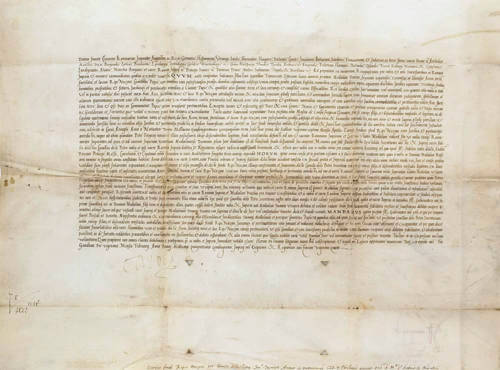
Imperial diploma on vellum signed by emperor Charles V
Stock number: 19867
Zoom ImageCartographer(s)
Emperor Charles V
Title
.. Rex Indiarum ac terre firme maris Oceani .. [ Emperor of the Americas ]
First Published
Ghent, 1540
Size
48 x 65 cms
Technique
Condition
excellent
Price
$ 16,000.00
(Convert price to other currencies)
Description
A rare and historically dramatic imperial diploma on vellum, personally signed by Charles V in his distinctive hand: "Caroly".
One of the most unusually elaborate and expansive titulatures surviving from the emperor’s hand, it proudly proclaims him sovereign over the “Indiarum ac terre firme maris Oceani” (“… of the Indies (Islands) and of the Terra Firme (Mainland) accross the Ocean Sea …”), an explicit early assertion of Spanish dominion over the newly discovered Americas that gives this magnificent charter special resonance for both European Habsburg collections and collections in America.
Documents signed by Charles V are already rare; full imperial diplomas on vellum from the height of his power, issued in such a politically charged moment, with such comprehensive titulature and this precise historical context, are of the highest order of rarity.
Charles V, Holy Roman Emperor (1500–1558). Magnificent imperial diploma on vellum granting the noble fief of Ripa Nazari (County of Pavia, Duchy of Milan) to Camillo della Petra, his loyal secretary and Spanish military commander of Ghent. Ghent, 20 February 1540.
A visually striking and historically dramatic Renaissance charter issued in the immediate, charged aftermath of one of the most vivid episodes of Charles V’s reign, the brutal suppression of the Revolt of Ghent (1539–1540).
Born in Ghent on 24 February 1500 in the Prinsenhof palace, Charles V returned to his native city in January 1540 at the head of an army to crush the uprising of the guilds, which had rebelled against heavy imperial taxation imposed to finance his wars. He treated his birthplace with calculated severity: ancient privileges were revoked, ringleaders executed, massive fines levied, and the citizenry publicly humiliated. On 14 February 1540 he entered the city in triumph. Just six days later, on 20 February, four days before his own fortieth birthday, he personally signed this lavish reward for Camillo della Petra (Camillus de Petra), the Spanish military commander of Ghent and one of the principal figures credited with the rapid and successful quelling of the revolt.
Rather than a routine letter of thanks, Charles granted della Petra the substantial feudal lordship of Ripa Nazari (a fortified estate with full jurisdictional rights near Pavia in the Duchy of Milan). The grant is framed explicitly as recompense for “good and faithful services” rendered to the emperor and the Holy Roman Empire, including those performed in Ghent. The timing and place of issue make this one of the most direct and personal rewards of the entire Ghent crisis: a tangible symbol of imperial gratitude, signed in the very city where the emperor had been born and where the revolt had just been crushed.
Physical Description
Single sheet of fine vellum, approximately 35 × 45 cm, written in dark brown ink in a clear, professional imperial chancery gothic cursive. Bold autograph signature of the emperor in his distinctive, sprawling “hanepoot” (chicken-foot) hand: “Carolus”. Contemporary archival docket at the foot of the recto and on the verso. The original pendant red wax seal is now missing (only the slits for the cords and faint traces of wax remain). Minor creasing and light soiling consistent with age and archival storage; otherwise excellent condition for a vellum document almost half a millennium old.
Historical Significance
Unusually elaborate titulature
The opening protocol is one of the most expansive and magnificent surviving examples of Charles V’s imperial style, proclaiming him “Emperor of the Romans Augustus, and King of Germany, of the Spains, of Both Sicilies, of Jerusalem, of Hungary, of Dalmatia, of Croatia, of the Balearic Islands, of Sardinia, of the Fortunate [Canary] Islands & of the Indies and of the Mainland (Terra Firme) of the Ocean Sea…” The explicit reference to “Indiarum ac terre firme maris Oceani” — the Indies and of the Mainland (Terra Firme) of the Ocean Sea — is the standard legal formula by which the Spanish crown asserted sovereignty over the newly discovered Americas. This early, prominent mention of the New World in a European imperial diploma is of exceptional interest to American collectors and institutions.
The phrase “Romanorum Imperator Augustus” at the very beginning is not decorative, it is a deliberate evocation of ancient Roman imperial grandeur. It signals that Charles V is exercising the highest possible authority on earth (in the eyes of contemporaries), legitimizing the grant of a noble fief as an act of an emperor who stands in the direct line of the Caesars. This titulature is one of the reasons the document feels so weighty and “imperial”: it is the formal language of world-ruling majesty, not the more modest style of a mere king.
Augustus = “the Exalted / the Revered / the Majestic One” his is the honorific that the first Roman emperor, Octavian, officially adopted in 27 BC. It carried powerful connotations of:
- supreme dignity and majesty
- divine or providential favor
- permanence and stability of rule
Ghent connection
Issued in the emperor’s birthplace mere days after he personally pacified the city, rewarding the Spanish commander who helped enforce imperial authority there.
Feudal grant in Milan
The text meticulously recites the earlier history of the fief (originally granted by Francesco Sforza, later held by the Fregoso family), its reversion to the imperial chamber upon failure of male heirs, and its re-grant to della Petra and his male descendants in perpetuity as an “honorable, noble, and gentle fief,” complete with full jurisdictional rights, immunities, and feudal obligations.
Appendix: Full Transcription and Literal Translation (available on request).
Significance
Imperial diploma on vellum signed by emperor Charles V
Related Categories
Related Items