Leen Helmink Antique Maps
Old books, maps and prints by Isidore-Stanislas Helman
Isidore-Stanislas Helman (1743-1806 or 1809)
Isidore-Stanislas Henri Helman was born at Lille on 29 January 1743 and received his first artistic training there, in the orbit of the city’s academy, a connection he continued to advertise in later life: several of his plates describe him as of the Academy of Lille in Flanders. Like most ambitious provincial engravers of his generation he went to Paris, and there he entered the studio of Jacques-Philippe Le Bas, the most influential teacher of intaglio engraving in eighteenth-century France. Le Bas trained a long succession of printmakers who dominated the trade in the second half of the century, and Helman was among the ablest of them. The connection matters for the work by which he is now best known, because Le Bas was himself one of the engravers employed on the Qianlong Emperor’s commission, cutting several of the sixteen large plates of the Conquests between 1769 and 1774. Helman therefore came to the Chinese material not as an outsider borrowing a fashionable subject but as a pupil of one of the men who had engraved the originals.
His early reputation rested on genre subjects. Through the 1770s and early 1780s he engraved after Jean-Baptiste Le Prince, the painter who had spent five years in Russia and returned with a repertoire of exotic and anecdotal scenes, and after other fashionable painters of the day. Plates such as Le Marchand de lunettes, of about 1776, and La Leçon inutile, after Le Prince’s painting of 1773 and engraved in 1781, were exactly the sort of graceful, saleable image that the Paris print market rewarded. By 1781 he was styling himself engraver to the Duc de Chartres, and he was publishing on his own account from premises in the rue Saint-Honoré, opposite the Hôtel de Noailles, with Ponce as a second outlet. Selling his own plates, rather than working only on commission for others, shaped the rest of his career: Helman was as much a publisher and entrepreneur as a craftsman, and he had a reliable instinct for what the public would buy.
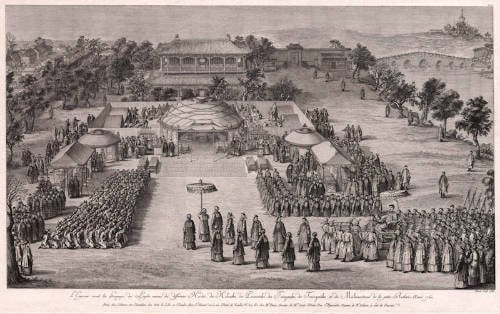
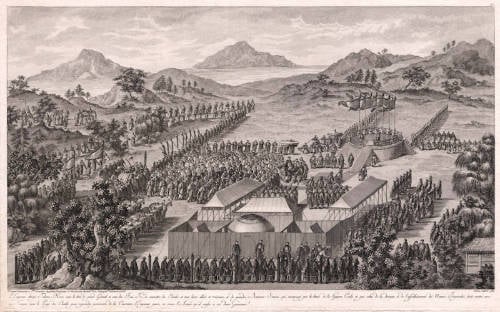
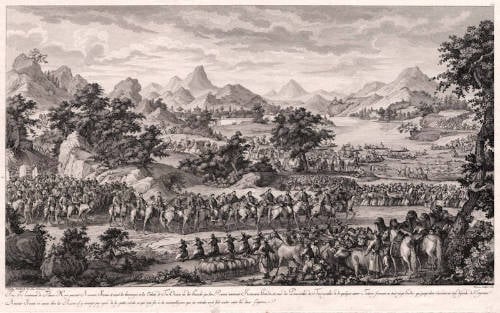
That instinct produced his Chinese publications. The Qianlong Emperor’s sixteen large engravings had been printed in Paris and sent almost in their entirety to Beijing, along with the copperplates themselves, so that scarcely any impressions remained in Europe and only a handful of privileged people, the king, his ministers, a few members of the court, ever saw them. French curiosity about China was at its height, and the commission had been the talk of the art world for a decade. Helman answered the demand with a reduced edition, re-engraving the compositions at roughly half size and publishing them between 1783 and 1785 as the Suite des seize estampes représentant les Conquêtes de l’Empereur de la Chine. Between 1786 and 1788 he added eight further plates of imperial ceremonies, bringing the work to twenty-four plates, issued with an engraved title and a leaf of captions, sold from his own address and by Ponce.
The captions are Helman’s own, and they are the most revealing part of the enterprise. He attributed them to a full-size set kept in the king’s apartments, but they are frequently inaccurate, muddling events, places and persons, and the plates are arranged in an order of his devising that Paul Pelliot, writing in 1921, dismissed as fanciful. Since Helman’s versions were the only ones most Europeans would ever see, his titles and his sequence governed the Western understanding of the Qianlong campaigns for well over a century, and they are still the source of several of the English titles in circulation today. In reduced format the compositions also change character. The violence recedes, the landscapes become decorative, and the scenes take on the charm of chinoiserie, closer to a French garden view than to a record of conquest.
Helman followed the Conquests with two further Chinese works in 1788, both drawing on Chinese woodcut books in the collection of the minister Henri Bertin: Faits mémorables des empereurs de la Chine, twenty-four plates of exemplary imperial deeds taken from the Ming Dijian tushuo, and an Abrégé historique des principaux traits de la vie de Confucius, produced in connection with the Jesuit sinologist Joseph-Marie Amiot. In these the translation into French taste is complete. Chinese figures appear in something close to eighteenth-century French dress, in imaginary landscapes of pavilions and pagodas, more like courtiers at Versailles than inhabitants of Beijing.
The Revolution gave him his last and most famous subject. Working after drawings by Charles Monnet, Helman engraved a series of the principal days of the Revolution, beginning with the opening of the Estates General on 5 May 1789 and continuing through the execution of Louis XVI, the Fête de la Régénération on the ruins of the Bastille, the Ninth of Thermidor and finally the events of 18 Brumaire at Saint-Cloud. He presented the plate of the king’s execution to the Convention in germinal of the Year II, and in 1798 he gathered twelve of the prints into a volume, advertising them in the Moniteur at half price for purchasers of the complete work, before adding three more plates to close the series. These images, widely copied, became the standard visual record of the Revolution for the nineteenth century and remain the works for which he is most often reproduced.
He died in Paris in 1806 or 1809; the sources disagree and the Bibliothèque nationale records both. His plates are held in the Cabinet des Estampes and in print rooms throughout Europe and America, and his output is catalogued in the Inventaire du fonds français, graveurs du dix-huitième siècle, volume XI. The fullest biographical account remains A. Vienne, “Essai sur la vie d’Helman,” in the Revue universelle des arts, volume 20 (1865), pages 263 to 274.