Leen Helmink Antique Maps
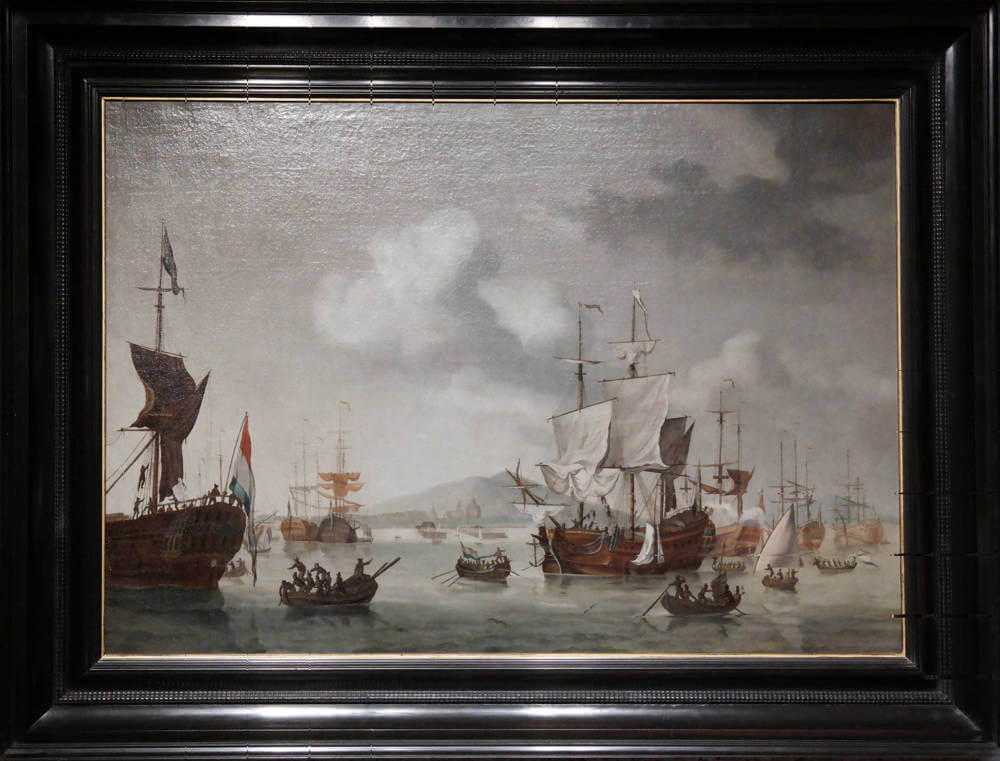
Batavia Roads by Hendrik Kobell ca 1775-1779
The item below has been sold, but if you enter your email address we will notify you in case we have another example that is not yet listed or as soon as we receive another example.
Stock number: 19953
Zoom ImageCartographer(s)
Hendrik Kobell Jr
Title
De Reede van Batavia / The inner roadsteads of Batavia
First Published
Rotterdam, 1775
This Edition
Size
59 x 83 cms
Technique
Condition
very good
Price
This Item is Sold
Description
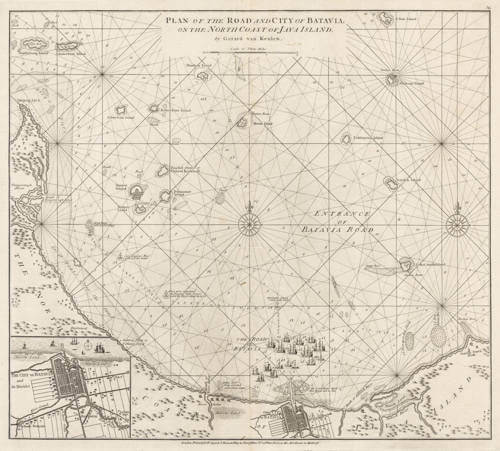
This oil painting by the short-lived Rotterdam marine specialist Hendrik Kobell Jr. depicts the busy inner roadsteads of Batavia (present-day Jakarta), the principal harbour of the Dutch East India Company (VOC). The view is confined to the sheltered area within the six-fathom boundary, rather than the much larger outer roadsteads that stretched from Krawangse to the Ruige Hoek (Ontong Java).
The composition conveys the constant activity of the anchorage: large Company ships riding at anchor, smaller vessels and boats moving between them, and the continuous loading and unloading of cargoes. Contemporary accounts describe scenes of this kind in almost identical terms. Cornelis van der Aa wrote of “the lovely view of Batavia roadstead \ldots giving a good idea of the activity, of the arriving and departing of the ships, together with the unloading and loading of their cargos.” An engraving by Mathias de Sallieth after a drawing by Kobell (dated 1772 and published 1779) records essentially the same prospect and confirms the artist’s direct observation of the harbour.
The inner roadsteads fell under the authority of the Commander (or Provisions Master), the senior naval officer of the VOC at Batavia. He resided in a house of 1644 south of the shipyard gate, known as the “palace,” and controlled the shipyard (the Wharf), the Vierkant (customs buildings), the repair facilities on Onrust and Kuyper islands, the lighthouse on Edam island, the harbour canal, the proas, and the onderlegger used for afloat repairs. The admiralty or guard-ship Mits desen (so named after the opening words of the official crew-transfer form), already recorded in 1654, lay under a separate skipper and flew the flag from the mainmast. From this vessel the morning and evening cannon shots were fired. A specialised sloop, the labberlot, maintained communication with the shore, while each ship was attended by its own Chinese-owned victualling prao (biermaat or kadraaier).
Kobell’s paintings are exceptionally scarce. Although celebrated in his lifetime for finely worked drawings and watercolours that entered the collections of Jacob de Vos and Cornelis Ploos van Amstel, he only began to translate his graphic work into oil relatively late, probably during a sojourn in England in the second half of the 1770s. In 1775 Stadtholder Willem V acquired a pair of his marine paintings for the gallery at the Buitenhof in The Hague; the pendant English Warships and a Moroccan Three-master in Distress during a Thunderstorm off the North African Coast is now in the Rijksmuseum. Had Kobell not died at the age of twenty-eight after leaping from a window in a delirious fever, he would almost certainly rank among the foremost Dutch marine painters of the later eighteenth century.
Literature
R. van Eijnden & A. van der Willigen, Geschiedenis der Vaderlandsche schilderkunst sedert de helft der XVIII eeuw, Haarlem 1816–1840, vol. 2, pp. 373–76;
Cornelis van der Aa, Atlas van de zeehavens der Bataafsche Republiek. Die van Batavia en Onrust, Amsterdam 1805;
F. de Haan, Oud Batavia, Batavia 1922–1923;
D.A. Rinkes (ed.), Het Indische Boek der Zee, Weltevreden 1925;
Wiepke Loos (ed.), Het Galante Tijdperk. Schilderijen uit de collectie van het Rijksmuseum, 1700–1800, Zwolle 1995, pp. 74–75.
Provenance
Collection H.F. Groen van Waarder, Amsterdam;
Sales H.G. Bom, Amsterdam, March 30 1906, catalogue nr. 47;
Private collection, Sweden;
Private collection, the Netherlands.
Related Categories
Related Items