Leen Helmink Antique Maps
Nova Reperta [and] Americae Retectio by Stradanus
The item below has been sold, but if you enter your email address we will notify you in case we have another example that is not yet listed or as soon as we receive another example.
![Nova Reperta [and] Americae Retectio by Stradanus](https://cdn.helmink.com/Inventory/Images/ysmall/19951.jpg "Nova Reperta [and] Americae Retectio by Stradanus")
Stock number: 19951
Zoom ImageCartographer(s)
Johannes Stradanus (biography)
Title
Nova Reperta and Americae Retectio
First Published
Antwerp, 1588
This Edition
Technique
Condition
mint
Price
This Item is Sold
Description
STRAET, Jan van der (Johannes Stradanus, 1523–1605).
Nova Reperta [and] Americae Retectio. Antwerp: Philippe Galle, [c. 1585–1600].
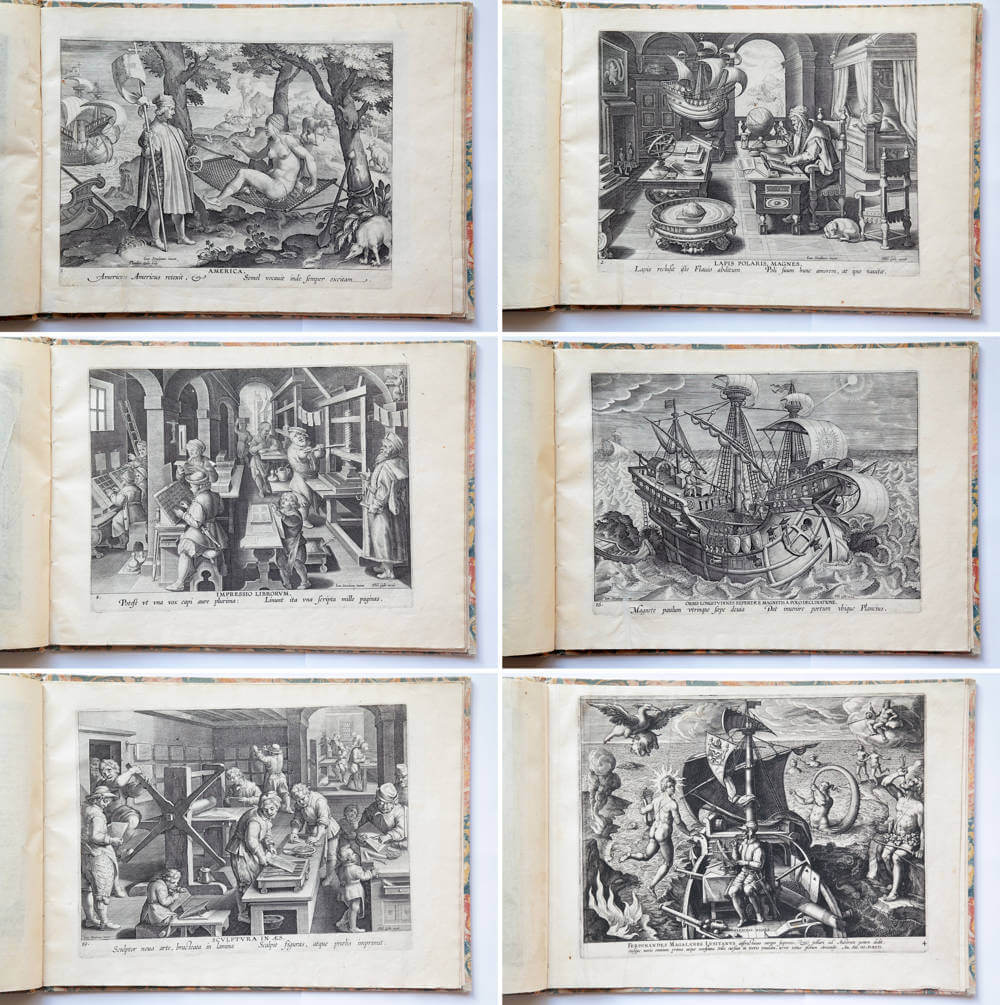
A superb and exceptionally rare complete album uniting the two great Stradanus print series in their rare first editions, bound together as one. Mint condition throughout.
Oblong quarto (plates c. 265 × 200 mm, with wide margins). Engraved title and 19 numbered plates of Nova Reperta by Theodoor Galle and Hans Collaert after Stradanus, together with the complete suite of 4 engraved plates of Americae Retectio by Adriaen Collaert after Stradanus. All plates fine, dark, early impressions in the earliest states, with full untrimmed margins, completely unrestored and free of any defects. In a fine later binding.
Nova Reperta (New Discoveries / Modern Inventions of our Time)
First editions, with early and ephemeral depictions of New World exploration and of 16th-century technology. The iconic series of twenty plates (title + 19) celebrating the great technological, scientific and geographical advances of the Middle Ages and Renaissance. Designed by Stradanus in Florence in the late 1580s and published in Antwerp by Philippe Galle.
The title page is illustrated with small vignettes of the inventions shown in greater detail in the subsequent plates. The series comprises:
- Discovery of America by Vespucci (with early depictions of New World fauna including a tapir and a sloth)
- Compass
- Gunpowder and cannon founding
- Printing press
- Clockmaking
- Medical treatment (guaiacum for syphilis)
- Distillation
- Silk culture
- Stirrups / farriery
- Water-mill
- Windmill
- Olive-oil press
- Sugar refining
- Oil painting
- Spectacles
- Navigation / determination of longitude
- Armoury / metal polishing
- Astrolabe and the Southern Cross (demonstrated by Vespucci)
- Copperplate engraving
The complete series is of the greatest rarity: the prints were originally issued unbound as loose sheets, and uniform complete sets in first state are virtually unobtainable outside a handful of major institutional collections (Metropolitan Museum, British Museum, Rijksmuseum, Newberry Library, etc.).
References: New Hollstein (Stradanus) 322–341; Old Hollstein 410–429; Sabin 92666 & 92667.
Americae Retectio (The Discovery of America)
One of the rarest “picture atlases” of the Age of Discovery (Tooley). Engraved by Adriaen Collaert after now-lost drawings by Stradanus and published by Philippe Galle, Antwerp, c. 1585 (reissued 1592 to commemorate the centenary of Columbus’s voyage).
- Title plate: large central globe showing Europe and America, supported by Flora (Florence), Janus (Genoa) and Oceanus, with medallion portraits of Columbus and Vespucci, and a bird’s-eye view of the Ligurian coast from Livorno to Savona.
- Christopher Columbus on the deck of his caravel, surrounded by Neptune, Diana, mermaids and sea-monsters, with the islands of the Caribbean and the American mainland beyond.
- Amerigo Vespucci holding a quadrant, accompanied by Hercules, Mars on a tortoise drawn by lions, and aquatic cannibals; the earliest European image of American fauna.
- Ferdinand Magellan entering the Pacific, with Tierra del Fuego, a Patagonian giant, and the famous monstrous bird carrying an elephant.
First edition, earliest states. Complete uniform sets are of the utmost rarity.
References: Sabin 92665; Hollstein (A. Collaert) 467–470; Tooley, “One of the Rarest Picture Atlases,” The Map Collector 2 (1978).
Rarity
Exceptionally rare first editions, bound together as one.
Provenance
Christie's New York auction 16082, lot 36.
Significance
Together these two series form the visual high-water mark of Renaissance celebration of discovery and invention. Nova Reperta presents the practical and technological achievements of the age in vivid workshop scenes; Americae Retectio elevates the great oceanic voyages into classical allegory. Both series were occasionally combined by contemporary collectors, but surviving albums containing both complete first-edition suites in mint condition are of the highest rarity and importance.
Condition description
Mint condition throughout. A museum-quality example of one of the most desirable and evocative print ensembles of the late sixteenth century.
Johannes Stradanus (1523-1605)
Johannes Stradanus, or Giovanni Stradano, or Jan van der Straet or van der Straat, or Stradanus or Stratensis (Bruges 1523 – Florence 2 November 1605) was a Flanders-born mannerist artist active mainly in 16th century Florence, Italy. Born in Bruges, he began his training in the shop of his father, then in Antwerp with Pieter Aertsen.
By 1545, he had joined the Antwerp guild of Saint Luke or painters' guild, the equivalent of the Roman (Accademia San Luca). He reached Florence in 1550, where he entered in the service of the Medici Dukes and Giorgio Vasari. The Medici court was his main patron, and he designed a number of scenes for tapestries and frescoes to decorate the Palazzo Vecchio in Florence, the Medici Villa at Poggio a Caiano, and providing illustrations for the Arazzeria Medicea. He also worked for the Pazzi Family in their estates in Montemurlo.
Many of his drawings became so popular they were translated into prints. Stradanus collaborated with printmakers Hieronymus Cock and the Galle family in Antwerp to produce hundreds of prints on a variety of subjects. He also worked with Francesco Salviati in the decoration of the Vatican Belvedere. He was one of the artists involved in the Studiolo of Francesco I (1567-1577), to which he contributed two paintings including "The Alchemist's Studio".
Karel van Mander wrote about Stradanus in his Schilder-boeck (book of famous painters), mentioning that he was 74 in 1603 and still a member of the Florence drawing academy. He also mentioned his pupil Antonio Tempesta, who painted ships and Amazon battle scenes (bataljes), mainly in 16th century Florence, Italy.
Johannes Stradanus is one of the most well-known unknown artists in history. Even though the Bruges-born painter (1523-1605) had a more than successful career in the highly competitive city of Florence in the second half of the 16th century, his name long remained a well-hidden secret for specialists only. Many of his works, though, are very well known.
Around 1570, Stradanus – who began as designer of tapestries and fresco painter in service of the Medici – started a second career as draughtsman and designer of hundreds of prints. These were engraved, published and distributed all over the then-known world by Antwerp publishers in huge numbers. It are these works – widely collected, copied and used – which secured Stradanus’s place in art history as an inventive and influential artist.
Johannes Stradanus died in Florence in 1605.
Literature
New Hollstein (Dutch and Flemish) 342-345 (Johannes Stradanus).
Stevens & Tooley: Map Collector 2, p.22-24, "One of the Rarest Picture Atlases".
van Mander: Schilder-boeck, 1604.
Sellink: Stradanus (1523-1605), Court Artist of the Medici, 2008.
Markey: Renaissance Invention - Stradanus's Nova Reperta, 2020.
Related Categories
Antique maps of the World
Old Master Prints
Antique maps of Italy
Antique maps of the Netherlands
Antique maps of Europe
Old and Rare Books and Atlases
Antique maps of Australia
Antique maps of the United States
Antique maps of South America
Antique maps of Central America
Antique maps of North America
Antique maps of Canada
Antique maps of America
Old books, maps and prints by Johannes Stradanus
Related Items