Leen Helmink Antique Maps
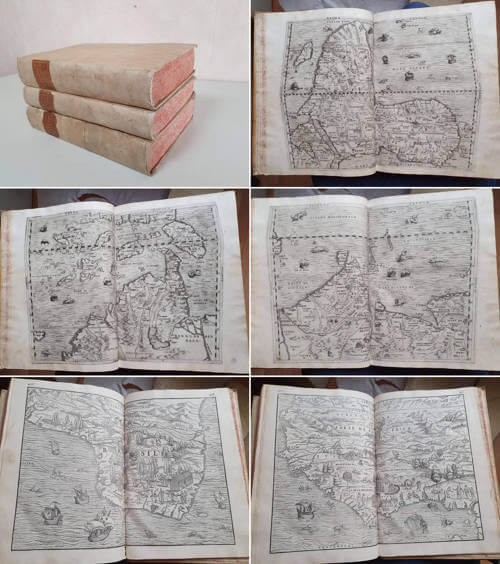
Complete set of Ramusio's Navigationi et Viaggi
The item below has been sold, but if you enter your email address we will notify you in case we have another example that is not yet listed or as soon as we receive another example.
Stock number: 19949
Zoom ImageCartographer(s)
Giovanni Ramusio (biography)
Title
Delle Navigatione et Viaggi
First Published
Venice, 1554
This Edition
Size
27.5 x 39.5 cms
Technique
Condition
excellent
Price
This Item is Sold
Description
Delle Navigationi et Viaggi raccolte da M. Gio. Battista Ramusio, in tre volumi divise …
Venice: Appresso i Giunti [Stamperia de’ Giunti], [mixed editions, typically 1563/1588/1606/1613 for Vol. I; 1574/1583 for Vol. II; 1556/1565/1606 for Vol. III].
Complete set of the three folio volumes of the most important systematic collection of voyages and travels of the sixteenth century, the first great scholarly anthology of its kind in a modern language, and the direct precursor of Hakluyt, Purchas, and the later voyage collections.
Ramusio (1485–1557), long-serving secretary to the Venetian Council of Ten, drew on official intelligence, unpublished manuscripts, and printed sources to assemble nearly one hundred narratives covering Africa, Asia, and the New World. Volume I treats Portuguese voyages along the African coast and into the Indian Ocean and East Indies (including Vespucci, da Gama, Alvarez, Pigafetta’s account of Magellan’s circumnavigation, and Leo Africanus). Volume II is devoted to Central Asia, Tartary, Russia, Persia, and the northern seas (with the first European mention of tea, Marco Polo in a critically important text, Hayton the Armenian, and later additions such as Barents). Volume III is entirely given over to the Americas and contains the first printings or key early texts of Verrazzano, Cartier (including the earliest printed plan of Montreal/Hochelaga), Cortés, Cabeza de Vaca, Coronado, Oviedo (Book XX first published here), and many others, together with detailed ethnographic, botanical, and zoological observations.
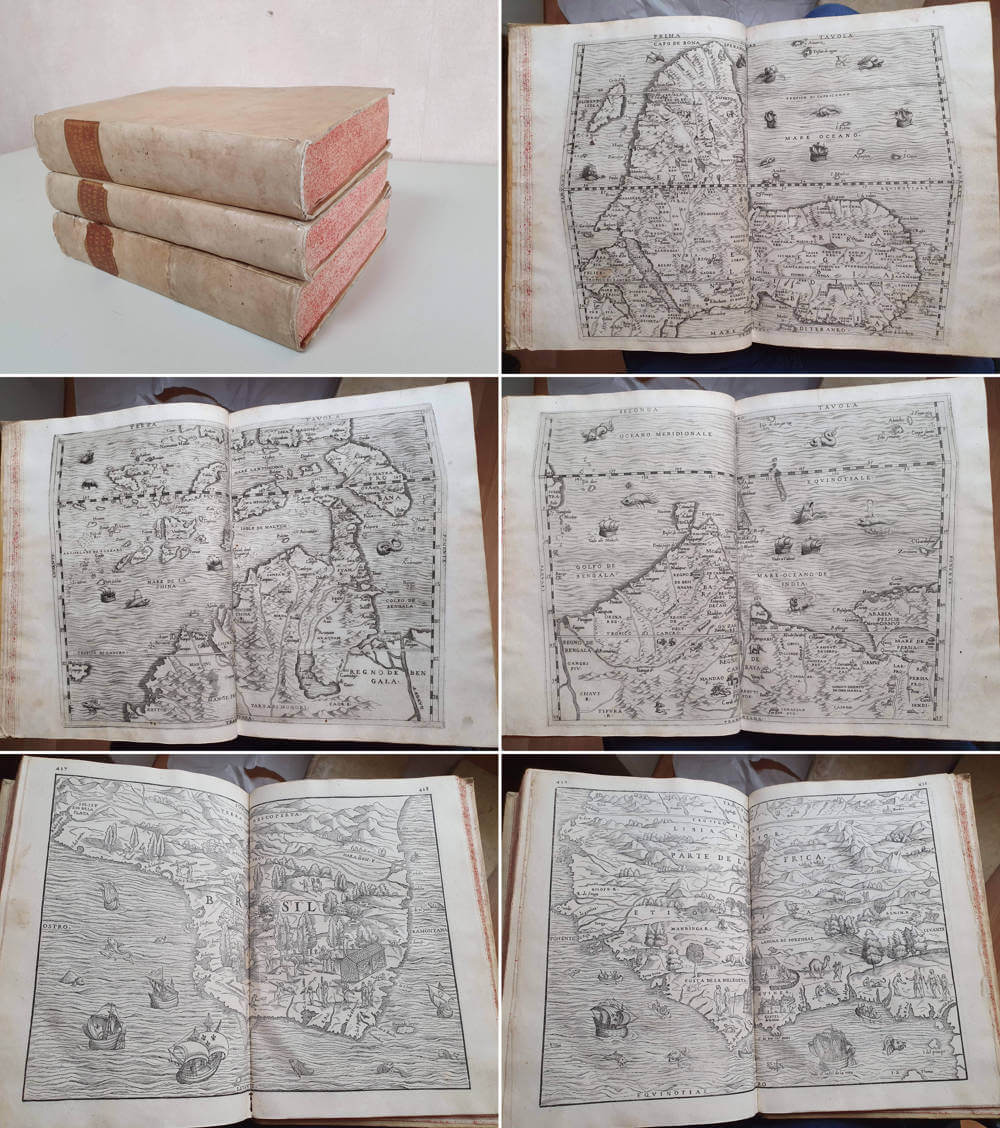
After a fire destroyed the original woodblocks at the Giunti press in 1557, the three celebrated double-page maps of Volume I, Giacomo Gastaldi’s south-oriented charts of Africa (Prima Tavola), South Asia/India (Seconda Tavola), and the Far East/Indochina (Terza Tavola), were re-engraved on copper. These copperplate versions (first appearing in the 1563 and subsequent editions of Vol. I) are sharper, more durable, and preferred by collectors. Volume III retains its suite of large folding woodcut maps and plans (Western Hemisphere, Brazil, Nuova Francia/Newfoundland, Hochelaga, Cuzco, Sumatra, West Africa, etc.), of which the 1556 first-edition impressions (pre-fire) are the rarest and most desirable; later editions use recut blocks. In total the set contains the three copperplate maps of Vol. I, seven or more large woodcut maps/plans in Vol. III, numerous in-text woodcuts of peoples, flora, fauna, and cities, and full indexes.
Sets are almost invariably mixed (different editions of the three volumes bound together), as the volumes were issued separately over more than half a century and later printings incorporated important additions. The most complete and sought-after combinations are those that include the copper-engraved maps in Vol. I and the fullest texts (e.g., 1583 for Vol. II; 1606 or 1613 for Vols. I and III).
A foundational work of Renaissance geography and exploration literature, indispensable for any serious collection of early Americana, Africana, or Asian voyages. Complete sets with the copperplate maps of Volume I in good impression remain scarce on the market.
Rarity
All three volumes are rare, complete sets even more so.
Condition description
Very handsome complete set, in contemporary and uniform vellum bindings. This is rare, because the volumes were issued separately over more than half a century and are therefore nearly always mixed bindings.
Giovanni Baptista Ramusio (1485-1557)
Ramusio is the first overview work of voyages of discovery. It was first published in 1550 (Volume 1, but not with maps until 1554), 1559 (Volume 2) and 1557 (Volume 3). All were published in Venice.
"Though he himself traveled little, Ramusio published Navigationi et Viaggi ("Navigations and Travels"); a collection of explorers' first-hand accounts of their travels. This was the first work of its kind. "Delle navigationi et viaggi" (Navigations and Travels) is a collection of explorer's first-hand accounts of their travels. It was the first work of its kind. It included the accounts of Marco Polo, Niccolò Da Conti, Magellan, Alvar Nuñez Cabeza de Vaca and Giosafat Barbaro, as well as the Descrittione dell’ Africa. The description of China contains the first reference in European literature to tea. He also published an excerpt of Tomé Pires' work on the Indies, which had come into his hands, though he did not know the name of its author. The first volume was published in 1550, quickly followed by the third volume in 1556. Publication of the second volume was delayed because the manuscript had been destroyed in a fire before being sent to the printer, and was finally published in 1559, two years after its compiler's death. Navigationi et Viaggi was translated into several languages and reprinted a number of times, indicating how popular such books were becoming on the Continent. It paved the way for a slew of other such works, including those of Richard Hakluyt."
(Wikipedia)
Related Categories
Antique maps of the World
Antique maps of Italy
Old and Rare Books and Atlases
Antique maps of Australia
Antique maps of Japan
Antique maps of China
Antique maps of the Philippines
Antique maps of Southeast Asia
Antique maps of India and Ceylon
Antique maps of the Middle East
Antique maps of Asia
Antique maps of South America
Antique maps of North America
Antique maps of Canada
Antique maps of America
Antique maps of Africa
Old books, maps and prints by Giovanni Ramusio
Related Items