Leen Helmink Antique Maps
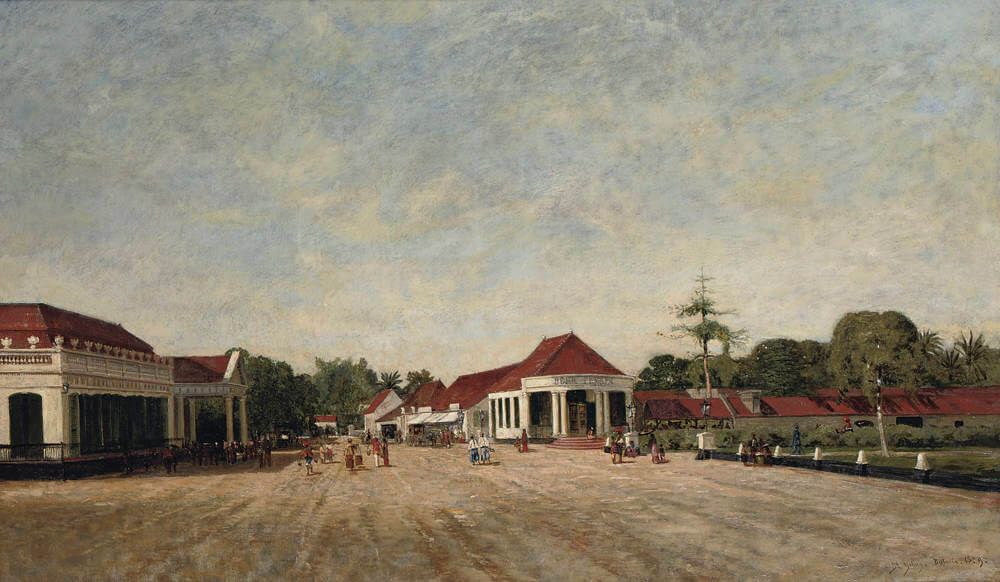
Early impressionist oil painting of Batavia
Stock number: 19925
Zoom ImageCartographer(s)
Auguste de Molins
Title
Daily Activities, Batavia
First Published
Batavia, 1859
Size
55 x 93.5 cms
Technique
Condition
excellent
Price
$ 47,500.00
(Convert price to other currencies)
Description
Famous early proto-impressionist painting of Batavia by Swiss painter Auguste de Molins (1821–1890).
Oil on canvas, 55 x 93.5 cm. Signed and inscribed lower right: A. De Molins. Batavia. 1859.
A rare and captivating street scene in Batavia (present-day Jakarta), centered on the prestigious Sociëteit de Harmonie and the elegant French boutique Oger Frères. Local street sellers and daily life animate the foreground with energy and atmosphere.
Painted during the artist’s travels in Java around 1858–1861, this work belongs to a very small group of authentic 19th-century oil paintings of the Dutch East Indies. Early views of Batavia are exceptionally rare on the market.
Stylistically, it is a fine proto-Impressionist example. De Molins uses loose, visible brushwork, a fresh sense of tropical light and atmosphere, and lively, abbreviated figures, bridging traditional Salon painting and the modern movement. He exhibited at the Paris Salon, including other Java subjects in 1863–64, and later with the Impressionists in 1874.
A well-known later photograph by Woodbury and Page from the 1870s of the identical view provides fascinating historical confirmation of the scene.
A historically significant and visually appealing record of mid-19th-century Batavia. An ideal addition for collectors of Orientalist, Batavia, Dutch East Indies, or early Impressionist-related works.
Daily Activities, Batavia, 1859
At the beginning of the 19th Century the old city of Batavia was largely demolished and replaced by a new set of buildings, parks and boulevards in the style of the French Empire and the Neoclassicists. Many buildings were constructed under the supervision of the governor-general of the Dutch East Indies Herman Willem Daendels, who was also in charge of building the fashionable French area in the Rijswijk district as depicted in the present lot by Auguste de Molins in 1859.
Auguste de Molins, a French artist who traveled extensively in the region around 1860, produced numerous very high quality prints documenting his travels there. The present painting is a remarkable early oil painting of the city first called Sunda Kelapa and Jayakarta.
The particular intersection of Molenvliet and Tanahabang which is shown here was also known as the Harmonie, named after the Harmonie Batavia Societeit, the fagade of which can be seen on the left side of the present lot. The impressive neo-classical building was constructed between 1808 and 1815 and was considered to be the largest of its kind in South-East Asia. It was the most popular meeting place for Europeans to talk, drink, smoke and dance in Batavia at that time. For the hard working plantation owners, visiting the soos was the only escape from their otherwise tough life. Every two or three weeks the plantation owners would travel for hours so that they could spend an evening there. The Harmonie Batavia Societeit later became known as the Djakarta Club.
On the right of the present painting, the boutique of the popular French fashion designers Oger Frhres is depicted, which attracted the elite of the community during the 19th century. This building does still exist and is now in use by a travel agency. In fact, very few buildings remain from Batavias colonial days. In 1985 the Harmonie Batavia Societeit was unfortunately demolished, but the present painting by De Molins gives us a striking representation of Batavia during the heyday of Dutch colonialism.
(Christie's)
Rarity
Early oil paintings of Batavia are exceptionally rare on the market.
Provenance
Christie's Amsterdam, February 27, 2008, lot 486.
Significance
Highly significant for collectors of Orientalist, Batavia, Dutch East Indies, or early Impressionist works.
Condition description
Excellent.
Related Categories
Related Items