Leen Helmink Antique Maps & Atlases
www.helmink.com
Romeyn de Hooghe
Curieuse aenmerckingen der bysonderste Oost en West-Indische ...
Certificate of Authentication and Description
This is to certify that the item illustrated and described below is a genuine antique
map, print or book that was first produced and published in 1682, today 344 years ago.
October 16, 2026
Cartographer(s)
Romeyn de Hooghe
First Published
Utrecht, 1682
This edition
Size
21.4 x 30.1 cms
Technique
Copper etchings
Stock number
19931
Condition
excellent
Description
Romeyn de Hooghe (1645–1708)
The East and West Indies: Eighteen Etchings in Both States
First state (i/ii), 1682.
From Simon de Vries, Curieuse aenmerckingen der bysonderste Oost en West-Indische verwonderens-waerdige dingen, Utrecht: Johannes Ribbius, 1682 (dedicated to the board of the VOC). Dutch legend and page number ("Pag:") in the plate; on white hand-laid paper.Second state (ii/ii), c. 1710.
From Les Indes Orientales et Occidentales et autres lieux, Leiden: Pieter van der Aa. Bilingual French–Dutch legends, added architectural and ornamental borders, publisher's address "a Leide, Chez Pierre vander Aa" and series plate number in the plate.Literature.
Hollstein (Dutch & Flemish) 1039–1086; Sabin 19854; Tiele 260; Cat. NHSM 240; Muller 1565. Comparative sets: Rijksmuseum, Amsterdam (album BI-1972-1043, 41 plates); The Metropolitan Museum of Art, New York.I. First State, 1682 (14 sheets)
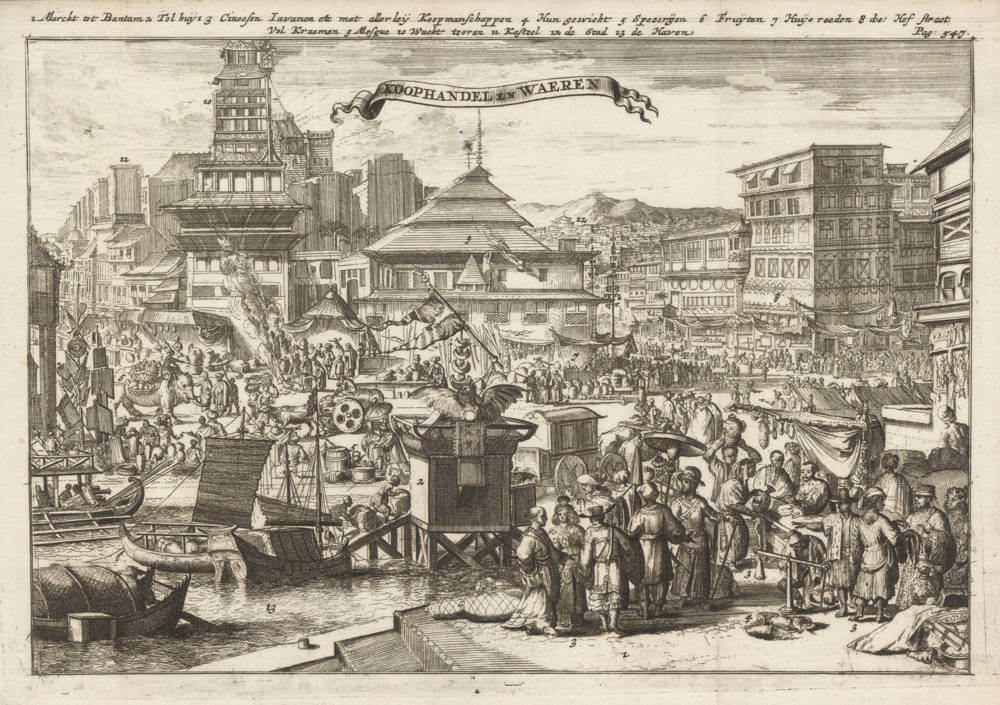
Koophandel en Waeren — The Market and Trade at Bantam
Pag: 547 (vol. 4). The great market of Bantam, Java: the toll house on piles in the harbour, Chinese and Javanese merchants with weighing scale, the Hofstraat with stalls, mosque, watchtower and citadel. The opening plate of the series. (Rijksmuseum BI-1972-1043-8)
Huwlyks Ceremonien — Wedding Ceremonies of Various Nations
Pag: 2. Marriage rites of the Tupinambá, Peruvians, Persians, Abyssinians, Muscovites, Hindustanis and Chinese, gathered in one panoramic scene.
Aflaet en Boet Papen — Indulgence and Penance Priests
Pag: 6, 7 etc. (vol. 3). Sin and penance: the weighing of a sinner, confession houses, hair-shearers and scourge-sellers, penitent hermits, the Hundred-Gods temple. (Rijksmuseum BI-1972-1043-20)
Bedel en Slacht Papen, Afgoden der Mexicanen — Begging and Sacrificial Priests; Idols of the Mexicans
Pag: 87 etc. Japanese mendicants, bathing brahmins and fakirs, fire-martyrs, the Mexican sacrifice to Huitzilopochtli ("Vitziaputsli"), Turkish dervishes.
Iapanse Afgoden — Japanese Idols
Pag: 109 etc. Caravanserai, Persian camel sacrifice, giant and devil images, Amida, Daomangi, Pussa, the Kobuqus temple and temple of riches; Chinese and Japanese worship.
Onderaerdse Gront op Malta — The Subterranean Grotto on Malta
Pag: 115 etc. The Spanish Grand Commander of Malta visiting the great cave-dwelling: cooking fires, baking ovens, stables and air shafts in a vast chiaroscuro cavern — one of the most atmospheric plates of the series.
Chineese Gasteryen en Pracht — Chinese Banquets and Splendour
Pag: 180 (vol. 3). Banquets with junks for the guests, sedan chairs, pipers at the doors, triumphal arches, comedies and masquerades, pleasure towers, washing ceremonies. Present in both states — see no. 15.
Duyvel en Afgoden Dienst — Devil and Idol Worship
Pag: 25 etc. Comans and Circassians, the goat sacrifice, Tartar dances, the Japanese procession, the procession of the Russian Tsar to the monastery, Chinese temples.
Turkse Slaverny en Gevanknis — Turkish Slavery and Imprisonment
Pag: 361. Tartar slave raids, the slave market, the alms-box at the Slave Tower, punishments, galleys in the roads.
Alle Asiatische Straffen — All Asiatic Punishments
Pag: 388. Ottoman, Persian, Japanese and Spanish-colonial justice assembled in one scene: the Chancellor of the Porte, the Seven Towers, Japanese crucifixions.
Spaensche Tyrannyen in de Westindies — Spanish Tyrannies in the West Indies
Pag: 474 (vol. 1). The cruelties of Alvarado's conquest and the destruction of Guatemala by water and fire — the series' famous Black Legend plate. (Rijksmuseum BI-1972-1043-40)
Asiatische en Afrikaense Dieren — Asiatic and African Animals
Pag: 532. Elephant, rhinoceros, hippopotamus, lions, crocodile, chameleon, flying fish and "thousand-legs"; ostrich and lion hunts; the Dutch fort at the Cape of Good Hope between Table Mountain and Lion's Head.
Abyssinisen op Toght — Abyssinians on the March
Pag: 940 (vol. 4). The Ethiopian emperor's camp and procession: the source of the Nile, raft bridges, tame lions, camel-tents of the nobles, altar stones and priests, the royal tent and treasure-hill. (Rijksmuseum BI-1972-1043-22)
Mogols Hof en Hofpracht — The Great Mughal's Court and Courtly Splendour
Pag: 1267. The court at Agra: elephant and camel thrones, silver trellis-work and gold balustrades, vassal kings, the fighting park, the fortress of treasures. Present in both states — see no. 16.
II. Second State, c. 1710, van der Aa (4 sheets)
Chineese Gasteryen en Pracht / Festins et Magnificence des Chinois
Series plate 18. As no. 7, with bilingual legend and architectural entablature border; publisher's address in the plate. State pair with no. 7.
Mogols Hof en Hofpracht / Cour et Pompe Royale du Grand Mogol
Series plate 26. As no. 14, with bilingual legend and border. State pair with no. 14.
Mogols Geboortedag-viering / Célébration du jour de naissance du Grand Mogol — Diamant mijn / Mine de Diamans aux Indes Orientales
Double plate with ornamental central pilaster. Left: Sir Thomas Roe, English ambassador, at the Mughal's birthday weighing ceremony against gold. Right: the diamond mines of Golconda with miners, cutters, priests and idols. (Compare Rijksmuseum BI-1972-1043 series, "Geboorteviering van Mongolië; Diamantmijn")
Konst Vueren / Feux d'artifices des Tartares — Musick en Speel Instrumenten / Instrumens de Musique de differens Peuples
Series plate 23. Double plate with marbled central pilaster. Left: the fireworks of the Great Khan's court. Right: musical instruments of the Persians, Turks, Javanese and Chinese, including water-bowl music and the Chinese music tower.
Rarity
Single plates from either edition are described in the trade as extremely rare in any edition; complete sets survive in only a handful of institutional collections, among them the Rijksmuseum (album, acq. 1972) and The Metropolitan Museum of Art. A coherent private group of eighteen sheets, spanning both states and including two subjects in state pairs, is of exceptional scarcity.
Condition
Etchings on hand-laid (verge) paper; first states on white paper with strong plate marks, second states on the warmer-toned paper characteristic of the van der Aa issue, with wide margins.
Romeyn de Hooghe (1645-1708)
During his lifetime, the etcher Romeyn de Hooghe (Amsterdam 1645 – Haarlem 1708) was renowned as the most important graphic artist of its era. “Who wants to learn the art of etching, should become an apprentice of the very well educated Romeyn de Hooghe”Inleyding tot de hooge schoole der schilderkonst (Introduction to the academy of the art of painting).
This enthusiasm for the work of De Hooghe was still unchanged in the twentieth century. The famous Austrian art historian Otto Benesch considered Romeyn de Hooghe as “the most genius Dutch illustrator and one of the most important etcher of all times. His work united the universality of baroque, of which in Holland he was the last representative of European stature ...” [Otto Benesch, 1964, p. 368].
The versatility and high artistic quality are characteristic of the works of Romeyn de Hooghe. His illustrations and loose prints cover all possible subjects. De Hooghe illustrated books of every conceivable genre. In the area of loose prints, special attention is attracted to the numerous news prints, allegories, portraits, maps, topographical prints and costume prints. A good insight in his many-sided work is offered by the publications of Landwehr (1970 and 1972).
Romeyn de Hooghe also designed and etched numerous title pages of books. One of the oldest of his hand is the frontispiece of Nicolaas Witsen’s Aloude en Hedendaegsche Scheeps-Bouw en Bestier (1671). Witsen was the leading authority in the area of ship building and ship design in the late 17e century, and his profusely illustrated publications were famous internationally.
A remarkable aspect of the style of Romeyn de Hooghe is the extremely fluent and smooth manner of drawing and etching. The illustrations are filled with many human figures that suggest action: everywhere is activity and motion. Seen from a distance, the crowds have a shaping quality; a closer look reveals however a huge amount of narrative details. Especially striking are the facial and emotional expressions of the people who are depicted. In much of his work he combines often newly invented allegorical elements, inspired by classical antiquity and the Bible, with more concrete and contemporary representations. With his pictorial technique he tried to achieve emotional involvement from the spectator. This effective combination of erudition and inventiveness, of imagination and sensationalism, made his work irresistible for his contemporaries and has lost none of its charm today.
In addition to graphic art, Romeyn de Hooghe was closely involved in the design and manufacture of cartographic works. Notable examples are the large and decorative overview wall maps of Delft (1675-78), Haarlem (1688-89), Rotterdam (1694) and the Hoogheemraadschap (Water Board) of Rijnland (1687). These maps consist not only of a cartographic image, but are surrounded by city profiles, coat-ofarms of governors, decorations, separate title banners etc. Another famous example is the large portolan chart of
maritime cartography of the 17th century.
Romeyn de Hooghe rapidly developed himself to the most productive and the most popular etcher of his time, and he produced a great amount of prints for various purposes, from small book illustrations to luxury print series on large format. Despite all this, very little of his work has come to us in colour, especially in the form of his loose prints or loose charts.
Literature
Otto Benesch, Meisterzeichnungen der Albertina, Salzburg, 1964.
John Landwehr, Romeyn de Hooghe (1645-1708) as book-illustrator. A bibliography. Amsterdam, 1970.
John Landwehr, Romeyn de Hooghe the etcher. Contemporary portrayal of Europe 1662-1707. Leiden, 1972.
Georges Keyes (ed.), Mirror of Empire. Dutch marine art of the seventeenth century. Minneapolis: The Minneapolis Institute of Art, 1990.
Günter Schilder, A manuscript sea atlas, drawn by Romeyn de Hooghe in 1681. In: Publicacoes do Centro de Estudos de Cartografia Antiga. Vol. 130 (Coimbra 1981) 17 pp.
Günter Schilder, Dutch wall maps of the 16th, 17th and 18th Century. To be published, 2024.
Günter Schilder, personal communication.
Henk van Nierop et. al. (eds), Romeyn de Hooghe. De verbeelding van de late Gouden Eeuw. Zwolle: Waanders Uitgevers / Amsterdam: Bijzondere Collecties van de Universiteit van Amsterdam, 2008. Exhibition Catalogue.
Henk van Nierop, The Life of Romeyn de Hooghe 1645-1708. Amsterdam University Press, Amsterdam, 2018. Exhibition Catalogue.